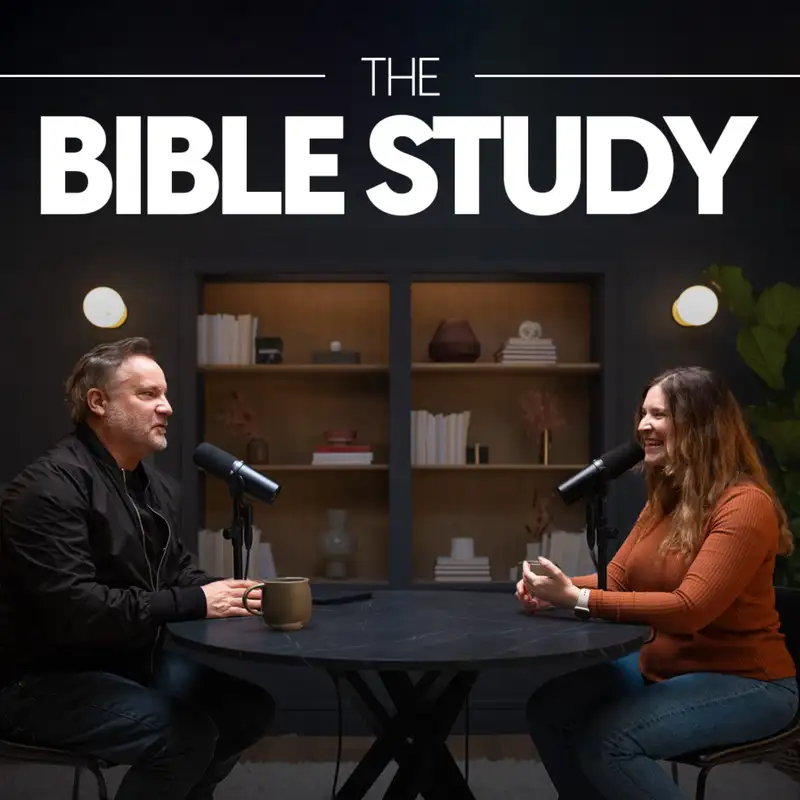
Curt Harlow [00:00:00]:
Hello, my friends, and welcome to the Bible Study podcast. We are in John chapter three, affectionately, in my mind. I call this Nick at night because this is the famous episode of Nicodemus the Pharisee. The. On the Sanhedrin. The big, big theological, credible, famous celebrity comes to Jesus in a nighttime meeting, and we get one of the most famous and referenced verses in all of the Bible. John 3:16. Out of this story.
Curt Harlow [00:00:36]:
We're going to go verse by verse through about the first 12 verses here. Dena, what would you add to that? Oh, joined by Kevin.
Dena Davidson [00:00:46]:
He's so familiar.
Kevin Thompson [00:00:47]:
Part of the family.
Curt Harlow [00:00:47]:
No, you're not. You are. You're not. You're not a guest, but at all. By the way, I'm Curt. That's Kevin. And then we've got Dena, the frontal lobe of thrive.
Dena Davidson [00:00:57]:
I got introduced.
Kevin Thompson [00:00:58]:
There we go. I like it.
Curt Harlow [00:01:00]:
I was listening to a few of these podcasts and I realized I drone on too long. So I'm trying to. As I drone on too long trying to get to it. So we're going to get to it today. All right, Nick at night. John 3:1 12. What am I missing about the context here? Dena, you want to add anything?
Dena Davidson [00:01:17]:
Just as the apostle John writing this, and he's giving us some views of scenes with Jesus that no one else has in all their gospels, and this is one of them, so it's very exciting.
Curt Harlow [00:01:27]:
Perfect.
Dena Davidson [00:01:28]:
Okay, let's read now. There was a man of the Pharisees named Nicodemus, a ruler of the Jews. This man came to Jesus by night and said to him, rabbi, we know that you are a teacher come from God, for no one can do these signs that you do. And then, unless God is with him, Jesus answered him, truly, truly, I say to you, unless one is born again, he cannot see the kingdom of God. Nicodemus said to him, how can a man be born when he is old? Can he enter a second time into his mother's womb and be born? Jesus answered, truly, Truly, I say to you, unless one is born of water and the spirit, he cannot enter the kingdom of God. That which is born of the flesh is flesh, flesh, and that which is born of the spirit is spirit. Do not marvel that I said to you, you must be born again. The wind blows where it wishes, and you hear its sound, but you do not know where it comes from or where it goes.
Dena Davidson [00:02:21]:
So it is with everyone who is born of the spirit. Nicodemus said to him, how can these things be? Jesus answered him, are you the teacher of Israel? And yet you do not understand these things. Truly. Truly, I say to you, we speak of what we know and bear witness to what we have seen, but you do not receive our testimony. If I had told you earthly things and you do not believe. How can you believe if I tell you heavenly things? No one has ascended into heaven except he who descended from heaven, the Son of Man. And as Moses lifted up the serpent in the wilderness, so must the Son of Man be lifted up, that whoever believes in him may have eternal life.
Curt Harlow [00:03:00]:
You stopped at the exact right place because we're gonna. We'll go full John 3:16 if you go anymore. Join us for the next episode. Okay, we're gonna do 20 weeks on this because there is so much in there. And Kevin, I'm gonna do what I always do. I'm going to ask you a leadoff question here, and then you're going to answer whatever question you want. Yes, but my lead. My leadoff question here is why is this in the beginning of the book? Is it simply chronological? John has seen that early on in his ministry, Jesus t changed water into wine and, you know, few verses later, he meets Nicodemus.
Curt Harlow [00:03:42]:
He kicks a bunch over tables, then he meets Nicodemus. Is it editorial license on John's part? Because he is saying in verse, chapter one, this is who Jesus is. So is this along that narrative? Why do we get this story right here?
Kevin Thompson [00:03:58]:
Yeah, anytime you look at John, I always take the passage first to John 20, 30, and 31. Right. John gives us the thesis that Jesus did many other things. These have been handcrafted, basically hand selected and written down so that y' all might believe and that by believing, y' all might have life. John is southern. I don't know if you're aware of that, but that idea of belief in life. So he's like a prosecutor now making a case, and we're the jury having to decide, is Jesus in fact the Messiah or not? And then his structure is. I call it a show and tell structure.
Kevin Thompson [00:04:30]:
So you have seven signs that he's gonna show us. Seven I am. Statements that he's going to tell us. And so we got the first sign a couple weeks ago in John chapter two, the water into wine. So then John also structurally loves contrast. Chapter one. It's light versus darkness. The chapter two, I think it's very intentional.
Kevin Thompson [00:04:47]:
He seems to move the temple story up to the beginning of the story where the other synoptic gospels put it at the end, to get this contrast between this miracle that happens at this wedding versus what happens in the temple. So the place you would expect Jesus to do the good thing, he does this thing that's unexpected. The place you would expect Jesus not even to be, he actually was. And that's where he shows his glory. Then I think we get these two back to back stories of a Pharisee who you would expect Jesus to immediately be recognized by, and a Samaritan woman that you expect Jesus never to be around. So I think John places it here for a very specific reason. He's trying to show all of us that we need Jesus, specifically these religious people who might be tempted to think that they don't need him. So right off the bat, I think we get the story of Nicodemus to show how this religious leader was coming in to ask Jesus, intrigued by him.
Kevin Thompson [00:05:37]:
I wrote in my Bible as Dena was reading, that whenever Nicodemus says, rabbi, we know that you are a teacher who has come from God, for no one could perform these signs. I wrote, is this enough?
Dena Davidson [00:05:46]:
Right, right.
Kevin Thompson [00:05:47]:
It's a great statement of faith, right?
Dena Davidson [00:05:49]:
Yeah.
Kevin Thompson [00:05:49]:
Is it enough? And so I think this story is here to introduce this idea, this question of what do you think about Jesus? And we're going to have two stories to kind of illustrate that.
Curt Harlow [00:05:59]:
Does it in any way lower our belief in the high inspiration of scripture that John is editing here for content reasons and for making sure you understand Jesus reasons?
Kevin Thompson [00:06:13]:
Yeah, I don't think so. I think, I mean, it's the power of the Holy Spirit, right? I think we are very chronological people and so we want everything in an exact order. So, man, I'm going to say there's two temple experiences instead of one because I'm uncomfortable with a different order. But at the same time, we do this all the time in storytelling. So I think, almost like a prosecutor, in his opening statement, I think he introduces the temple story early on to show the conflict that Jesus is going to have for the rest of his ministry. I. I think he places this story here because he's making a case.
Dena Davidson [00:06:45]:
I once interviewed an actor. I was asking him, like speaking coaching tips, and he said that story. I was asking him how to be a great storyteller. And he gave me this line I've never forgot. He said, story is the deliberate disorganization of information. He said, you know what a boring story is? That's how I preach deliberate disorganization. That's like that. It's such a boring thing to hear this happen, then this happen, then this happen.
Dena Davidson [00:07:08]:
That's how we teach kindergarteners to write. But Great authors. Like, think of your favorite movie. Oftentimes what happens in movies is you set up the drama, you take them to a part that's right in the middle, and then you flash them back and you show them how they got there, and then you play the story forward. So I think people that write, people that tell stories, they're familiar with these ideas, right? Like, it's not disingenuous, it's not inaccurate. They. This is just good storytelling.
Curt Harlow [00:07:36]:
No one looks at the very first Star wars movie made and says, why is that Episode three or four, whichever one it was. Yes, we understand that this is purposeful to communicate a bigger meaning 100%. So I do think he went into the temple more than once.
Dena Davidson [00:07:51]:
I do too.
Curt Harlow [00:07:52]:
You know why I'm a parent. You know the amount of times I had to tell my kids to stop doing something really stupid.
Dena Davidson [00:07:58]:
Yes.
Curt Harlow [00:07:58]:
Yeah, yeah. Could have been more than one. Okay, so.
Dena Davidson [00:08:01]:
But our faith doesn't hinge right on it, it being one or the other.
Kevin Thompson [00:08:04]:
Y' all can be wrong and still be faithful. I like that.
Curt Harlow [00:08:06]:
Before we get to the main interaction between Jesus and Nicodemus, John wants us to know that he was a Pharisee and a Jewish part of the Jewish ruling council. Why are we. Why are those two things important for us to know, Dena?
Dena Davidson [00:08:24]:
So we read that word Pharisee, and, and we see it as a taboo word, right? Like, oh, oh, this means this guy had problems. Like, if you know the Jesus story, then you know that Jesus has all sorts of corrections for the Pharisees. They were seen as hypocritical. Jesus calls them whitewashed walls and a brood of vipers and all of these things that we're going to find out later. But for a moment, scrub your mind of those things and think about it like a first century Jewish person. A Pharisee would have been a respected religious person. It would have, like, think of your favorite pastor, the person that you would go to for advice, the person you would go to to model your life after. That's what the word Pharisee meant to these people.
Dena Davidson [00:09:11]:
So I think John is telling us something important. He's a Pharisee. He's an important, respected religious ruler. And. And before we read, you know what's going to happen later in the story, we have to understand it, how they would have been.
Curt Harlow [00:09:24]:
Yeah. And I also think if you add Pharisee to Jewish Ruling council, you get the most qualified person to actually know how to get to God. So, you know, Nicodemus would have been a member of 6,000 different Pharisees at that time. But all 6,000 weren't on the Sanhedrin. They were not on the Jewish Ruling Council. Nicodemus would have been a member of 70. You got to think about it this way. If I went through my rabbi's little school in my village and then I graduated to the next level of the next most important rabbi, and I ended up at the most important rabbi in Jerusalem, and he was my teacher.
Curt Harlow [00:10:10]:
And out of that I was invited to be on the Sanhedrin. I have, you know, I've got my. It's like those people that get one doctorate and then go on to get two more. And. And this is, this is who Nicodemus is. He's.
Dena Davidson [00:10:25]:
You should tell them the background of the Pharisees. Like before we started pushing play.
Curt Harlow [00:10:29]:
Let me just say this. If I lived in the first century, I would have been a Pharisee, 100% Pharisee. Now we. What we mean by.
Dena Davidson [00:10:36]:
I just heard you say that you're very brilliant.
Kevin Thompson [00:10:37]:
After I would have got the third doctorate.
Curt Harlow [00:10:42]:
Okay, no, no, no, no, no. I have a fine arts degree and there was about 10 people that went to my seminary. So. No, what I meant is our understanding of Pharisee. I would have been a part of the society of the Pharisees as opposed to the society of the Sadducees. Sadducees were Hellenized and they're aristocratic and they valued the temple ritual over actually day to day adherence of the Torah and the oral Talmud, which is like the collection of the best commentary on. On the Old Testament. And so what happened with the Pharisees? They were born out of the Maccabees conflict.
Curt Harlow [00:11:27]:
And they kind of had this idea of we should live Torah every single day. And not only should we live Torah every single day, we should live what the best rabbis have said about Torah. So the oral Talmud and the Torah should be 24 7. And we should be resisting Hellenization.
Dena Davidson [00:11:48]:
What do you mean by Hellenization?
Curt Harlow [00:11:50]:
Okay, so there's this group called the Maccabees. The Maccabees were priest warriors in Jews in the Jewish kingdom. And they came against basically before Christ, Macedonians. And because they felt like the Macedonians in their occupation of the Holy Land were Greekifying everyone. So this is the conflict we see in the New Testament between those that come in for Passover and Pentecost, that live out in Asia Minor and those that are Jewish Jews in Judah with extra Judasauce. These. These are the conflict culturally within Judaism. So what the Maccabees said is, we refuse to become Hellenized.
Curt Harlow [00:12:34]:
We are going to be for God that class of warrior priests. There was a certain amount of the population that said, we will pledge to you and we are going to be unhellonized. We're going to keep the purity, and we're going to make Jerusalem, we're going to make Israel great again. And so this, their passion was to remain pure and to withhold and stand aside the word of God and let it be watered down. This is way more appealing to me than to say, I'm an aristocrat who wants to be in cahoots with Rome to appease them so that I can have my Holy Temple days. Right. But then once the Holy Temple days are over, I'm. I kind of.
Curt Harlow [00:13:24]:
Those two worlds are not integrated as much. I like the instinct more of, like, this is going to be a 247 thing for me. I'm.
Kevin Thompson [00:13:31]:
This would have been a Sadducee. That's the game.
Curt Harlow [00:13:34]:
He would have been, yes, I want
Kevin Thompson [00:13:36]:
to be in cahoots. You would have been the thing.
Curt Harlow [00:13:37]:
I would have been cahoots. You would have lived in a nicer neighborhood than me. And so. But here's the thing. What's surprising whenever you see the Pharisees in the New Testament, what's surprising is Jesus as a revolutionary should have been on their side. And Jesus is a person that said, love God with all your heart, mind, soul, and love your neighbor as yourself should have been on the side of the Pharisees. And I think we don't see more interaction with Sadducees just because they're not there. They're aristocratic.
Curt Harlow [00:14:06]:
The Pharisees are at least in the audience, the Pharisees are at least confronting him. This Pharisee on the Sanhedrin is coming to Jesus. This is why it makes more sense when Paul says, I was a Jew among Jews. I was a Pharisee born of Pharisees. So what? He's. He's bragging there. I'm a 247 Jew, not an aristocratic cultural Jew. That mind doesn't mind a little Roman and Hellenistic influence.
Dena Davidson [00:14:31]:
And if you've been following the whole Old Testament and you know that there's been 500 years of silence, like, the last thing that we know is that the. Over and over again, the Israelites were punished for capitulating to the cultures around them.
Curt Harlow [00:14:44]:
Yes.
Dena Davidson [00:14:44]:
It's the very thing they were punished for.
Curt Harlow [00:14:45]:
Yes, yes.
Dena Davidson [00:14:46]:
So it's literally the Pharisees were this moment where they were the ultimate Daniels. They were saying, we're not gonna go that path that our fathers traveled. We will be separate from our culture. And so up until this moment, they're kind of heroes, but they're heroes in a period of total silence from God. And all they can hold onto is what God had said and done in the past, because there hasn't been a prophet, there hasn't been a fresh revelation. And so you've got these people who are holding onto rules and rituals and all they can in their Jewishness, and they're about to be confronted with something new, like a new word from God.
Curt Harlow [00:15:24]:
Jesus has one thing against the Pharisees, and it isn't that they're more horrible or more sinful than others. He has one thing against them. And by the way, it's the same thing against the Sadducees, and he has the same thing against me. It's just the Pharisees, their mission statement emphasized the one thing that he has against us. Now, the good news, Kevin, is in the end, the Sadducees and the Pharisees work together. The bad news, in the end, they work together to crucify Christ because of the one thing that Jesus has. When he says, you're whitewashed tombs, he's not saying you're the only whitewashed tombs. He's making a theological statement about the human soul and how we work our way to God.
Curt Harlow [00:16:11]:
So without giving it away, he's going to confront Nicodemus on the one thing he has against every Pharisee, and he has against you in me.
Kevin Thompson [00:16:20]:
Proof that it wasn't enough. His. His statement, yes, you're a great teacher. Nope, not enough.
Curt Harlow [00:16:25]:
Okay, let's talk about this very famous phrase, born again, and which I might argue might be the best metaphor ever made by anyone, ever. And the sad thing about the idea of born again is that it's become a moniker or a. You know, it's kind of like the title of our society now, instead of actually looking at it as the powerful word picture that it actually is. So what's the proper way? When we look at Jesus saying, very truly, I tell you, verily, verily, in the King James, no one can see the kingdom of God. And unless they are born again. What is the right way of looking at that phrase, born again? I think as a mom, you've got to have.
Kevin Thompson [00:17:16]:
Strangely, I don't feel like I could just. Well, let me tell you.
Curt Harlow [00:17:19]:
Well, maybe I'd give her the last word.
Dena Davidson [00:17:23]:
What it means to be born again is. Is that Your whole, like your whole self is made new. So in the same way that baby undergoes complete transformation when it is formed in its mother's womb and then it enters into the world to that level of change is what happens to us as humans. What theologians would say is what happened at the Fall is that our hearts were curved in on themselves. And what happens when we are born again is that our hearts are reoriented towards God. So to be born again means that we have a completely different way of relating to God, completely different way of relating to ourselves, and a completely different way of relating to others and the world around us. Everything about us is transformed and made new due to this being born again. So it's.
Dena Davidson [00:18:15]:
It's a beautiful idea. I think it's really sad that culturally, it's almost like a sneer, right? Oh, you're one of those born again Christians.
Curt Harlow [00:18:23]:
Or on the other bit, not a serious. It's a statement of exclusivity. We're born again.
Dena Davidson [00:18:28]:
Oh, yeah. I guess that's even worse.
Curt Harlow [00:18:30]:
It is really. We're really perverting the essential beauty of it. Not to say that it isn't exclusive when you become a Christian. That is an exclusive group, but it's exclusive by grace. So.
Kevin Thompson [00:18:46]:
Yeah. Not like you can take credit for it. No, I mean, that's one of the aspects of what this looks like is I can take no credit for being born the first time.
Curt Harlow [00:18:55]:
How many children do you have, Dena?
Dena Davidson [00:18:56]:
Three.
Curt Harlow [00:18:57]:
And each of your children, how much did they help in the birthing process?
Dena Davidson [00:19:01]:
I would say they inhibited it.
Curt Harlow [00:19:03]:
Yes.
Dena Davidson [00:19:04]:
They were less than helpful.
Curt Harlow [00:19:05]:
No, exactly 100%.
Kevin Thompson [00:19:07]:
So that concept. And then also I think it was Jason Cain who was quoting Tim Keller, which. We're all smarter when we quote Tim Keller about that idea of how the baby gets a new sense of sensibilities, that in the womb you have one thing, you come out, and now suddenly touch, smell, taste, all these things have to be reoriented to the world in which you're in. So that transformation that has to take place whenever our eyes are closed off to the grace of God, when they get opened, how it changes our senses in how we perceive and understand the world.
Curt Harlow [00:19:36]:
Yeah. I also wanted, you know, this is one of my favorite things to do is ask myself the question, how is this phrase different here now in the age of nicus and hospitals and everything we know about birth and in the first century? So to be born in the first century, to go back and be born again is to put yourself in the most vulnerable state. A human can be put into. We are as, as infants, completely. We will die in hours without absolutely and total provision. And our provision changes. Source. We go from an umbilical cord to we have to be fed to your point about the change from interior to exterior.
Curt Harlow [00:20:29]:
But every single first century person that read this knew of many babies who had passed past, had died, that needed absolute protection to a level we don't understand. And they also knew about the pain of childbirth in a different way than we know about the pain of childbirth. So to me, it's the most powerful way of saying, as a Jewish pharisee of the ruling council, you believe that seeing the kingdom is having the right Jewish mother. Right. Right heritage and obeying the laws. Enough. Obeying them passionately, rigorously, zealously. And if I have those two things, I'll see the kingdom.
Curt Harlow [00:21:15]:
And Jesus is saying no, it's so much more the opposite of that. It is making yourself before God as not just an infant, but a newborn infant. Like the analogy I used to use when I would teach this with my students is you guys, guys have no idea because none of you have kids. But when they send you home from the hospital, they send you home with a diaper that you don't get arrest all the time. And it's this teeny little thing. Like the first one I saw, I was like that. Now they don't say teeny, they grow pretty quickly. But it is such a fragile and precious level of dependence.
Curt Harlow [00:21:59]:
It's another way of saying, a powerful way of saying you have to have ultimate and all encompassing faith in God to see the kingdom. You are not going to do anything to get you to see it, except for acknowledge your infancy and the striking
Kevin Thompson [00:22:17]:
nature of that to this powerful man, this religious leader, the one that we're all striving to achieve after. That's what's so striking to me and is, I mean, even later on Jesus's words. How do you not understand these things?
Curt Harlow [00:22:32]:
No, that's the whole point. I set you up as Dr. Pharisee and Governor, Jewish ruling council and then you say the most bonehead thing that can be said. Whereas, contrast with the Samaritan woman who immediately goes into theological conversation with Jesus and she's kind of right, and he gives her, he has this more in depth theological conversation with her and then she reaches the right conclusion. Here's a man who knows everything.
Kevin Thompson [00:23:03]:
When he comes, he will explain everything.
Curt Harlow [00:23:05]:
Yes, she says yes. Yeah, she went to night school. Okay, very true. I tell you, no one can enter unless they are born of water and the Spirit. Okay, why does Jesus bring the Spirit in here? So we see that Nicodemus is very learned, very powerful, and yet he doesn't understand the idea of faith and grace. Jesus uses this powerful metaphor of faith, which is the dependence of an infant. And then he says, now you have to also understand the Spirit's role in this. Why does he bring the Spirit into this?
Dena Davidson [00:23:48]:
Well, I think Nicodemus initially heard it as a physical rebirth, right? Like a physical second birth. And so Jesus, again, is like, you're not getting it. And so he has to bring in and say, this is about the Spirit. This, once again, this is not about the physical thing that you have control over. This is something that is completely outside of your control. This is God himself doing this work. And I think. We think, okay, New Testament is all about the Holy Spirit, and we don't have the Holy Spirit in the Old Testament.
Dena Davidson [00:24:21]:
The Israelites would have been aware of God having his Spirit working through them. They didn't have the concept of the Trinity yet, but God is Spirit. Like, that concept was there. And so when they. When he heard about being born of the Spirit, he would have understood this is an act of God, right? This is God himself doing the work. And without that delineation, Nicodemus would still have been thinking in very physical terms and not in a this is a divine act of God terms.
Kevin Thompson [00:24:53]:
So do you. Do you think the. I mean, it's debated, but do you think the water here is the water of baptism? Or do you think it's literally the breaking of the water at birth, which is the image.
Dena Davidson [00:25:02]:
I heard like, even a third interpretation, which is that water in the Spirit is literally just. It's just a phrase that means the same thing, being born again. And so I don't know. I think this is one of those areas that's a little bit unclear in Scripture. It could be water baptism. It could be physical. I know you lean towards the physical and then the spiritual.
Curt Harlow [00:25:22]:
I tend to think it's the water, the breaking of water, of pregnancy. And the reason is. What I believe he's trying to say is you are. Your first birth was a labor of your mother, to which you added nothing. And the second birth is a labor of the Spirit of God. And it's the same labor. It's a painful labor, it's a sacrificial labor, and it is a labor that the Spirit does entirely without any of your help. So he's saying that the two are similar in that you had no contribution to either of them.
Curt Harlow [00:26:05]:
Both are sacrificial and painful, and both come through like, you know, labor. You know, the way we see labor in the movies is happy pregnant woman is painting her kitchen at eight weeks and six days, and then all of a sudden, she goes into labor. And in the cab on the way to the hospital, she has the baby. And of course, everyone that's a parent knows that labor begins at month two. That morning sickness is labor. That. That uncomfortable seventh and eighth month where Kelly could not sit in any position and fully breathe is labor. And that before active labor pains happen, there is Brackman Hicks, there is.
Curt Harlow [00:26:56]:
There's the body rehearsing the labor. And so labor is so much more than that moment of birth that we like to. Is the most dramatic thing we put on TV and movies. Same analogy here. God is working, and the mechanism of salvation is not you at all.
Kevin Thompson [00:27:17]:
I loved how Amy said it today of nobody, nobody is physically born without the sacrifice of another.
Curt Harlow [00:27:23]:
Yes.
Kevin Thompson [00:27:23]:
And that idea of how it then ties into our spiritual rebirth is equally true.
Curt Harlow [00:27:27]:
Yeah. And in verse 6, it says, Flesh gives birth to flesh.
Kevin Thompson [00:27:30]:
Mom.
Curt Harlow [00:27:30]:
Spirit gives birth to spirit. God. And then. Go ahead.
Dena Davidson [00:27:35]:
I'll just say I love verse 8. Picking up the theme of how outside of Nicodemus's control. This is the wind blows where it wishes. You hear its sound, but you do not where it comes from or where it goes. So it is with everyone who is born of the spirit. It's just basically like, this is God's intention. This is God's choice. This is an act of God on a human soul.
Dena Davidson [00:27:54]:
This is God from start to finish. It's not within your control. You. You leader of these people that does not know where you're leading them is essentially what Jesus is saying. Yes.
Curt Harlow [00:28:03]:
Yeah, there's. There's. Sometimes students will ask me, back in my old campus ministry days, you know, I heard that Jesus started Christianity, then Paul took it over, and Paul changed everything. Where do you find the book of Romans in the New Testament? This is it right here. The wind blows wherever it pleases. You hear its sound, but you cannot tell where it comes from. Now, the word for wind, Blessing town was bringing this up and the word for spirit are very similar words here. So there's an interplay here.
Curt Harlow [00:28:34]:
And what we're meant to catch by the interplay is God does what he wants. He's sovereign. He's completely in control. It is completely. I have not done anything to have this happen. So all of the great learning of Nicodemus, all of his late Nights doing homework, memorizing the Torah, all of his great efforts to memorize the oral Talmud and all of the rabbis, none of that added to his salvation at all. He will see the kingdom of God because the wind of the Spirit came and grabbed him and took him there. So to me, it's a powerful testament to this.
Curt Harlow [00:29:20]:
We underestimate or under emphasize in our saved by grace through faith the role of the Spirit. So if you read the book of Romans, of course it teaches that we are saved by grace through faith. But equally as much in there is the life of the Spirit. Be in the Spirit, follow the Spirit. Paul is convinced that not only can you not be saved without the mechanism of the Spirit through grace, but you can't live the Christian life without the Spirit, that even after we get saved, then we go and go, that was so great, God, I'm going to live great for you now. No, it's the Spirit that empowers everything. He does what he wants, as he wants to do, do it. We're to be carried along by it, not to white knuckle our way into God's favor.
Dena Davidson [00:30:11]:
Very good. Very helpful.
Curt Harlow [00:30:13]:
All right, so now that we've figured it out, here we go. What is the takeaway for us, you guys? What is the. See, I just want to be in the. I want to put myself in the shoes of Jesus and not be in the shoes of Nicodemus in this passage. Because Jesus is so heroic and beautiful and smart and very, very verily, I tell you. And like I said, I think it's the best metaphor maybe ever used ever on any topic. But if I'm going to be courageous and put myself in the seat of Nicodemus, what should my takeaway for studying this passage be? What's my application?
Dena Davidson [00:30:52]:
I think mine is just let Jesus show you how much you do not know. Because Nicodemus starts by saying, we know, and then Jesus systematically shows him his ignorance, even though he claims to have knowledge. And then Jesus ends by saying, we know. Like, we speak of what we know, and you don't know, but I know. And so I think the more you have grown up in a church, the more you have studied theology, the more Bible study podcasts you have listened to or been on, the more you need to let Jesus show you how much you do not know. Because if you're trusting in your knowledge, then you are always going to fall prey to the sin of the Pharisees, which was elevating their knowledge above the God that they thought they knew. And so, so much so that when the God that they thought they knew stood in front of them, they didn't recognize him. So let God show you how much.
Curt Harlow [00:31:49]:
How would you go about doing that? Dena, what's one practice question thing I could do to understand where I am as a learner or to not let any arrogance get into where I am as a learner?
Dena Davidson [00:32:02]:
Yeah, for me, it's just not glossing over things I do not understand, but really bringing them into God's presence and saying, God, just be honest, I don't really understand Hell, not sure why you chose to set things up that way. Your verses seem to conflict. So really pausing when you find something that you don't know about and bring it into God's presence and say, help me to understand, help me to believe what is true. And then the more that you get comfortable being ignorant, I think that the more that God can fill your mind with the things that are true instead of what you think is true.
Curt Harlow [00:32:37]:
That literally happened to me last weekend when Jesus said, when it says about Jesus, he did not entrust himself to them.
Dena Davidson [00:32:45]:
Yeah.
Curt Harlow [00:32:46]:
And I'm like one thought, I trust Jesus. That's only there. This goes both ways. And as I studied it, I was like, oh, this is fascinating. This is about me not being a fan of Jesus, but a true follower. But yeah, I looked at it as I am not sure what that means.
Dena Davidson [00:33:04]:
Yeah.
Curt Harlow [00:33:04]:
Kevin, how would you apply this?
Kevin Thompson [00:33:06]:
Well, I think for one thing, it just makes me fall in love with the Bible again even more. And that John is a book like we study passages, but to get the argument inside of a book and then the power of doing it in group think. I think maybe outsiders wouldn't realize how much we actually study the Bible together. Sermon prep places like this, and then they're doing their private Bible study by themselves and wondering why sometimes they struggle to understand the text, not realizing we would be in the exact same spot. So whenever I look at this passage from that context of what John is doing in making his case, I think what strikes me here is we don't know what happens to Nicodemus. There's some guesses he shows up in later places, but it's like he intentionally leaves us on a cliffhanger. Because the question is not what happens to Nicodemus. The question is what's happening to the listener, to the reader in this moment.
Kevin Thompson [00:33:54]:
So as I would love to debate Nicodemus salvation. No, no, no. Let's debate my own right. And am I now truly following? Because I can easily say what Nicodemus Said here we know that you're a teacher who has come from God. Great. That's not good enough. Have I truly experienced now this change of identity, of sensibilities, this transformative experience by the spirit of this salvation that should now change absolutely everything? That's what kind of confronts my heart in this passage.
Curt Harlow [00:34:22]:
That's great. I think I would have said both of those, but you already just said them, so I'm going to come up with one on the spot.
Dena Davidson [00:34:32]:
That's even better.
Curt Harlow [00:34:33]:
Yeah, that's even better. No, I. Here, here's the thing. Nicodemus is a strange mix to me of FOMO and foja. I just made that one up.
Dena Davidson [00:34:44]:
You're gonna have to define that one.
Curt Harlow [00:34:46]:
Fear of missing out. He comes at night. Okay. See the signs? This is some, you know, like some say we can't really tell why he came at night. Maybe it's just, I don't, I, I don't subscribe to that. I think he came at night because he had a big title and big position. He was well known and he got stopped in a safeway every time he went shopping. And I think that's why he came at nine.
Curt Harlow [00:35:06]:
So he. But he overcomes that. He has a fear of missing out, but then he also has a fear of joining in. Fogy foji.
Kevin Thompson [00:35:15]:
He doesn't say, nick, you right, but
Curt Harlow [00:35:17]:
fear, we don't, we don't get the satisfying. Oh, then I, Jesus, help me then be born again.
Dena Davidson [00:35:25]:
That's not the.
Curt Harlow [00:35:25]:
And so I guess what I would say, similar to you, Kevin, as I would say the first question you have to ask yourself is, am I as dependent on God as an infant? Have I truly surrendered? Or am I living a pharisitical life? And I. By that I don't mean that you're mean spirited or that you're clobbering people over the head with rules. I mean that you're trying to work your way to God. So that would be a question I would ask myself, especially if you grew up in church or been going to church for a long time. The second thing I would say is don't. The idea of being born again is such a powerful idea that I think we ignore the second half of the passage about the role of the Spirit. So maybe there's time to invite the empowering of the Holy Spirit in your life and say, I cannot see the kingdom, I cannot know you, Jesus, but the Spirit, I also cannot do anything day to day. I cannot love my spouse.
Curt Harlow [00:36:30]:
I cannot fulfill my calling. I cannot say no to the right. I mean, no to the wrong and yes to the right. Without the power of the Spirit of God. And I think there's no one that will get to heaven and say, you know what, Jesus? When a second that went by where I wasn't depending on the Spirit and living the life of the Spirit, I think we all wander away from the true power source of the Christian life, which is grace fueled relationship with the Spirit of God. Grace, empowerment from the Spirit of God. So just spending that time going, am I living this? Holy Spirit, I humble myself before you, Jesus. Fill me again with your spirit.
Curt Harlow [00:37:17]:
Lead me in your spirit. Let me hear the still small voice of your spirit. Let me walk in the gifts and the calling of the Spirit. Just renewing that emphasis on the Spirit in your life would be a great response to this if you are a believer. All right, we are moving on to the most quoted New Testament verse next week. Who we got coming, Bri? Next week?
Dena Davidson [00:37:41]:
Surprise.
Curt Harlow [00:37:42]:
It will be a surprise. Well, Dena will be here, I'll be here, and Jesus will be here.
Dena Davidson [00:37:48]:
And the Spirit.
Curt Harlow [00:37:49]:
I think we're going to look at the amount of views we had this week and decide if we're inviting Kevin back. So if Kevin's podcast, which is called what Kevin?
Kevin Thompson [00:37:58]:
Change the odds.
Curt Harlow [00:37:59]:
Change the odds. It's on marriage and relationship. If that gets more views, he's never coming back.
Kevin Thompson [00:38:03]:
Then y' all aren't coming back.
Curt Harlow [00:38:04]:
Is that. That might be true too. Actually, do you know something I don't know? Were you at a board meeting? Okay, all kidding aside, you know, the problem is with really familiar verses is sometimes they're so familiar we don't actually understand them. And so next week we're going to get the opportunity dissect John 3:16. And I think it's going to be absolutely spectacular. Thank you for joining this week. Spread the word and join us again next week as we continue our study in the Gospel of John. Jesus in his own words, the Jesus you never knew.
Curt Harlow [00:38:38]:
We'll be back next Wednesday with that John 3:16 passage.